
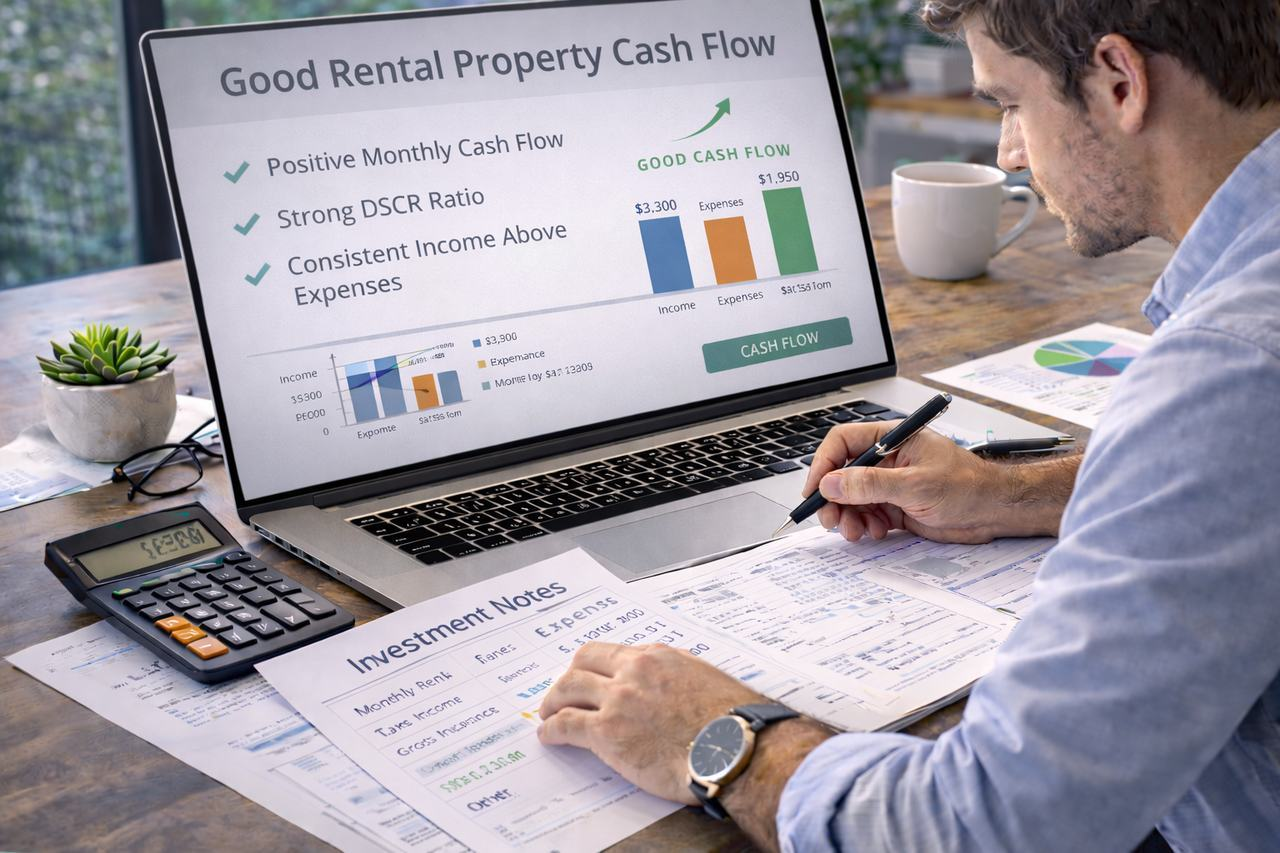
What Is a Good Cash Flow on a Rental Property?
One of the most common questions landlords and investors ask is what counts as good cash flow on a rental property. The honest answer is that there is no single number that fits every market, every property type, or every investor strategy. A cash flow number that looks strong in one market may be weak in another once taxes, insurance, maintenance, and rent stability are considered.
Still, there are useful ways to think about this question. Good cash flow is not just about having a positive number on paper. It is about having enough monthly margin to handle real world ownership without constant financial stress.
If you are new to this topic, start with our main guide to rental property cash flow.
A good cash flowing rental property is one that produces enough monthly income after expenses to justify the risk, support repairs and vacancy, and still contribute meaningfully to your long term financial goals.
Why Positive Cash Flow Alone Is Not Enough
Some investors assume that if a property cash flows by any amount at all, it is a good deal. That is too simplistic. A property producing only a very small monthly surplus may still be highly vulnerable to one repair, one insurance increase, or one short vacancy period.
For example, a property generating only a thin monthly margin may technically be cash flow positive, but that does not necessarily make it strong.
Good cash flow should be viewed in context:
- How much cash flow is left after realistic expenses
- How stable the rental income is
- How old and maintenance heavy the property is
- How much reserve cushion the owner has
- How the property compares to other deals in the same market
What Good Cash Flow Usually Means in Practice
In practical terms, good cash flow usually means the property produces enough monthly income to do more than just barely survive. It should give the owner room to absorb normal ownership friction.
That includes things like:
- Routine maintenance
- Vacancy periods
- Insurance increases
- Property tax increases
- Turnover costs
- Unexpected repairs
A rental property that produces healthy cash flow gives the owner options. A property with very thin cash flow creates pressure.
The strongest rental properties are not always the ones with the highest rent. They are often the ones with the best combination of stable income, controlled expenses, and enough margin to survive real world ownership.
How to Judge Whether Cash Flow Is Good
Rather than relying on one universal dollar amount, investors should judge cash flow using several questions.
1. Does the Property Leave Room After All Realistic Expenses?
If your cash flow calculation only works by ignoring maintenance, vacancy, or capital expenditures, the number is not strong enough.
2. Can the Property Handle a Normal Problem Without Becoming Negative?
A good property should be able to absorb at least some friction without immediately requiring owner subsidy.
3. Is the Cash Flow Meaningful Relative to the Purchase Price and Risk?
A small monthly surplus may not justify the risk of ownership, especially on older or more management intensive properties.
4. Does the Property Support Your Long Term Strategy?
A good cash flow number for one investor may be weak for another depending on whether the goal is passive income, portfolio growth, or appreciation.
Good Cash Flow Depends on Market and Property Type
Cash flow should always be judged relative to the type of property and the market where it is located.
For example:
- Lower priced Midwestern properties may produce stronger cash flow
- Higher priced coastal properties may have thinner cash flow but better appreciation potential
- Older properties may need more monthly cushion because repairs are more likely
- Short term rentals may produce higher gross income but less stable net cash flow
This is why comparing raw numbers across markets can be misleading.
You may also want to compare:
Examples of Weak, Acceptable, and Strong Cash Flow
These are not rigid rules, but they help illustrate the concept.
Weak Cash Flow
The property technically stays positive, but only by a very small margin. One repair or short vacancy could wipe out several months of profit.
Acceptable Cash Flow
The property produces a reasonable monthly surplus after realistic expenses and can absorb normal ownership friction without immediately becoming a problem.
Strong Cash Flow
The property leaves enough monthly income to support reserves, cover normal surprises, and still contribute meaningfully to the investor’s goals.
A property that looks strong before reserves, vacancy, and maintenance can quickly look weak once those real world costs are included. Good cash flow should always be based on realistic underwriting, not best case assumptions.
Why Thin Cash Flow Can Be Dangerous
Thin cash flow is one of the biggest hidden risks in rental property investing. A property that barely works on paper may feel fine during smooth months, but real ownership is rarely smooth all year.
Thin cash flow becomes dangerous when:
- The tenant leaves unexpectedly
- A major repair hits
- Insurance or taxes rise sharply
- Leasing takes longer than expected
- The property has older systems with more maintenance risk
This is why many experienced landlords would rather own fewer strong properties than more marginal ones.
How Financing Changes What Counts as Good Cash Flow
Financing structure has a major effect on cash flow. A property may look strong with one loan structure and weak with another. Higher rates, larger loan balances, or shorter terms can all reduce the monthly margin.
Some investors explore financing options based on whether the property income supports the debt payment, especially when evaluating rental acquisitions and refinances.
For investor financing guidance, see DSCR loans for rental property investors.
Strong financing does not create a good deal by itself, but weak financing can definitely weaken one.
Good Cash Flow Should Still Be Stress Tested
Even if the monthly number looks strong, investors should ask how the property performs under pressure.
Stress test questions include:
- What happens if rent is slightly lower than expected?
- What happens if vacancy lasts one extra month?
- What happens if insurance rises?
- What happens if a major repair happens this year?
If the property still looks workable after those questions, the cash flow is probably far healthier than a deal that only works under perfect conditions.
Related pages:
- rental property break even analysis
- risk analysis for rental properties
- how to calculate rental property cash flow
Good cash flow is not created only at the time of purchase. It is also protected through good tenant screening, strong leasing execution, timely maintenance, and low vacancy. For landlord education and operational guidance, explore Blue Castle Management.
Cash Flow vs Appreciation Tradeoff
Some investors are willing to accept lower cash flow in exchange for a stronger appreciation story. Others want stronger immediate monthly income and are less concerned with future price growth.
Neither approach is automatically right or wrong. The better question is whether the cash flow level matches your strategy and risk tolerance.
If your goal is immediate monthly income, thin cash flow is usually a poor fit. If your goal is long term appreciation and you have strong outside income or reserves, you may accept a lower monthly number.
What New Investors Often Get Wrong
New investors often ask for a target cash flow number without first understanding the property itself. That can lead to distorted decisions.
Common mistakes include:
- Focusing only on rent minus mortgage
- Ignoring maintenance and turnover
- Comparing deals from totally different markets
- Assuming appreciation will cover weak cash flow
- Underestimating how often real expenses occur
The right question is not just “what number is good?” It is “is this number strong enough for this property, in this market, under realistic conditions?”
A Better Way to Think About Good Cash Flow
A good rental property cash flow is one that:
- Remains positive after realistic expenses
- Provides enough monthly margin to handle ownership risk
- Fits your market and property type
- Supports your portfolio goals
- Does not rely on perfect assumptions to work
That definition is far more useful than chasing a random dollar target.
- Good cash flow is not just any positive number
- It should leave enough room for vacancy, repairs, and normal ownership stress
- Market, property type, and financing all affect what counts as good
- Thin cash flow can be much riskier than it first appears
- Strong underwriting matters more than chasing a universal target number
Frequently asked questions
What should owners know about What Is a Good Cash Flow on a Rental Property??
What Is a Good Cash Flow on a Rental Property? should be evaluated as a practical operating decision, not just a one-time task. Small process gaps can affect vacancy, risk and cash flow.
When should a landlord ask for help?
A landlord should ask for help when vacancy, screening, maintenance coordination, legal notices or decision fatigue start affecting the property’s performance.
What is the next step?
The next step is to compare the current rental process against a documented management or leasing plan and identify the highest-cost bottleneck.