
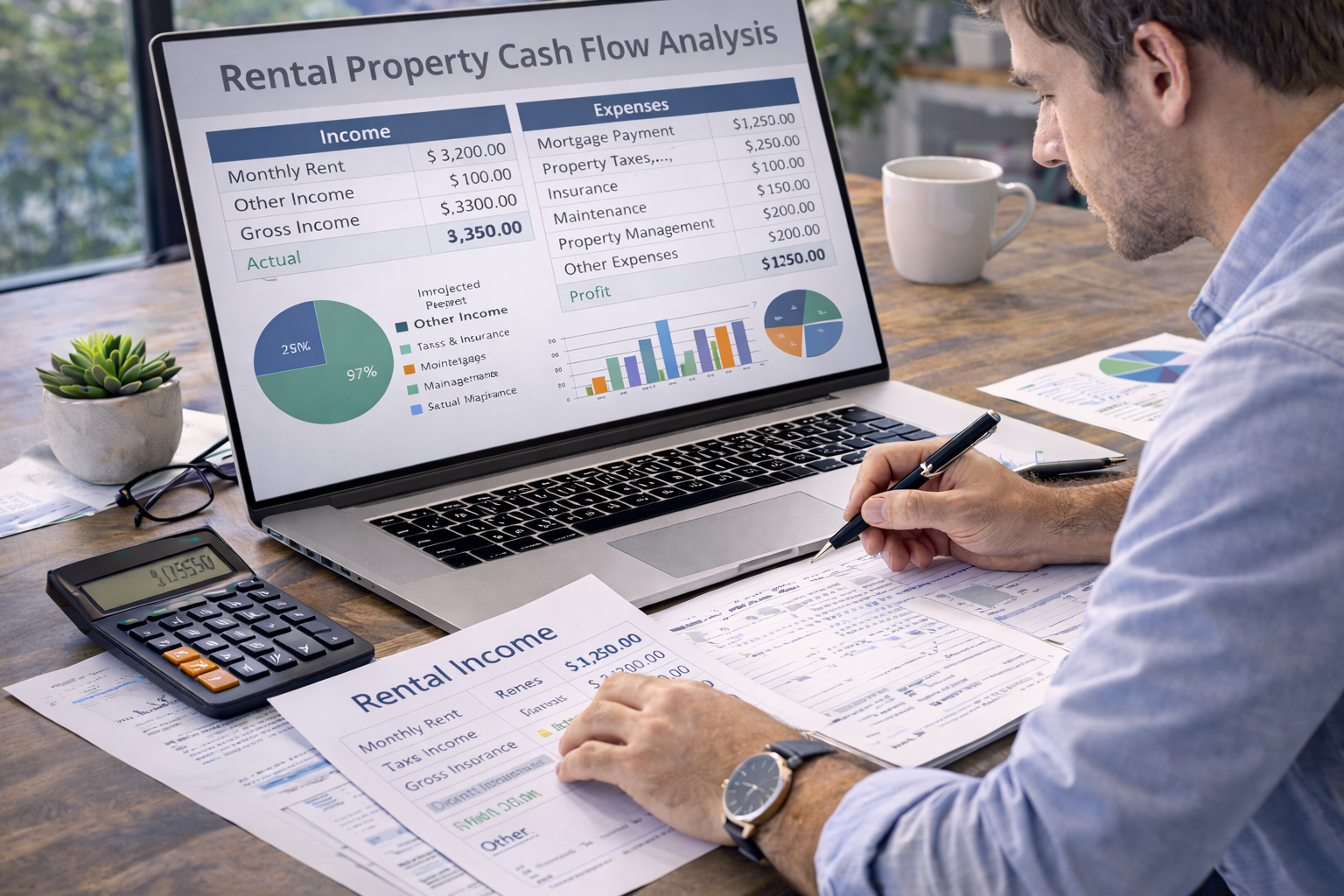
How to Calculate Rental Property Cash Flow
Knowing how to calculate rental property cash flow is one of the most important skills a landlord or investor can develop. A property may look attractive based on the purchase price or monthly rent alone, but the real question is simple: how much money is left after all expenses are paid.
Cash flow is what determines whether a rental property helps strengthen your finances or quietly drains them. Investors who calculate it correctly make better decisions, avoid thin deals, and build portfolios on a stronger foundation.
If you are just starting with this topic, begin with our main guide to rental property cash flow.
Rental property cash flow is calculated by subtracting all monthly property expenses from all monthly rental income.
Cash Flow = Total Rental Income − Total Property Expenses
Step 1: Calculate Total Monthly Rental Income
Start by identifying all reliable sources of monthly income connected to the property. For many landlords, this is simply the base monthly rent. Some properties also produce additional income that should be included if it is recurring and realistic.
Possible income sources include:
- Monthly tenant rent
- Pet rent or pet fees
- Parking fees
- Storage fees
- Laundry income
- Other recurring tenant charges
Be careful not to inflate this number. Use realistic rent based on current leases or well supported market rent, not best case assumptions.
A property only looks as good as the rent assumptions behind it. Conservative rent estimates usually lead to better investment decisions than optimistic projections.
Step 2: Identify All Monthly Property Expenses
This is where many investors go wrong. They remember the mortgage payment but underestimate everything else. To calculate true cash flow, you need to include all recurring and expected ownership costs.
Common expenses include:
- Mortgage principal and interest
- Property taxes
- Landlord insurance
- Property management fees
- Maintenance and repairs
- HOA dues if applicable
- Utilities paid by the landlord
- Vacancy allowance
- Capital expenditure reserves
For a full operating cost breakdown, see our page on rental property expenses.
Step 3: Subtract Expenses From Income
Once you have realistic monthly income and realistic monthly expenses, subtract the expenses from the income.
If the result is positive, the property produces positive cash flow. If the result is negative, the property requires you to contribute money each month.
Example:
- Monthly rent: $2,200
- Other monthly income: $100
- Total income: $2,300
- Total monthly expenses: $1,950
- Monthly cash flow: $350
That property would generate $350 in positive monthly cash flow before additional unexpected costs.
Positive cash flow on paper does not mean the property is automatically strong. The numbers still need to be tested against vacancy risk, repair exposure, and realistic rent expectations.
Step 4: Account for Vacancy and Repairs
A common beginner mistake is assuming full occupancy every month and minimal repair costs. Real rental property ownership rarely works that cleanly.
Even a good property should usually include:
- A monthly vacancy allowance
- A monthly maintenance reserve
- A capital expenditure reserve for larger future costs
For example, if rent is $2,000 per month, you may want to reserve a percentage for vacancy and maintenance rather than assuming every dollar is spendable profit.
This is one reason conservative underwriting tends to outperform aggressive underwriting over time.
Step 5: Calculate Annual Cash Flow Too
Monthly cash flow helps you evaluate the property’s day to day performance, but annual cash flow gives you a broader view of how the investment performs over time.
The formula is simple:
Using the earlier example, a property generating $350 per month would produce:
$350 × 12 = $4,200 annual cash flow
This annual figure becomes useful when comparing different investment properties and evaluating return metrics.
How Financing Changes Rental Property Cash Flow
Loan structure has a major impact on monthly cash flow. Even a property with strong rent can produce weak cash flow if the financing is too aggressive or the monthly payment is too high.
Many investors use loan structures that consider the property’s rental income when qualifying. One common example is a DSCR loan, which is designed around whether the property income supports the debt payment.
For investors evaluating financing options, see:
DSCR loans for rental property investors
Understanding how financing affects the monthly payment is essential when calculating real cash flow.
What Expenses New Investors Commonly Miss
The biggest cash flow errors usually come from expenses that were overlooked or minimized. Commonly missed items include:
- Vacancy periods between tenants
- Leasing or tenant placement costs
- Maintenance on older systems
- Insurance increases
- Property tax increases
- HOA special assessments
- Utility bills the owner ends up paying
A property that looks strong without these costs can look much weaker once they are added back in.
Strong cash flow is not just about buying the right property. It also depends on tenant screening, leasing execution, maintenance control, and limiting vacancy. For landlord education and operational guidance, explore Blue Castle Management.
Cash Flow vs Profit
Cash flow and profit are related, but they are not always identical. Cash flow focuses on actual money left after operating costs and debt service. Profit can be shaped by tax treatment, depreciation, accounting methods, and capital expenses.
For day to day decision making, many landlords care more about cash flow because it tells them whether the property is supporting itself in real time.
How to Compare Two Rental Properties
When comparing two rental properties, calculate cash flow for both using the same conservative method. Then compare:
- Monthly cash flow
- Annual cash flow
- Vacancy risk
- Repair exposure
- Long term rent stability
One property may have higher rent, but another may have lower expenses and more stable returns. Cash flow helps bring the comparison back to the real numbers.
You may also want to review:
- what is a good cash flow on a rental property
- rental property break even analysis
- risk analysis for rental properties
Why Cash Flow Matters More Than Many Investors Think
Cash flow is not just a number on a spreadsheet. It determines how resilient your investment is when things go wrong. A property with thin margins is far more vulnerable to repairs, vacancy, and rising costs.
A property with strong cash flow gives you more room to:
- Handle repairs without stress
- Build reserves
- Cover vacancy periods
- Reinvest into future properties
- Rental property cash flow is calculated by subtracting total expenses from total rental income
- Accurate calculation depends on including all realistic ownership costs
- Vacancy and maintenance reserves should be built into the analysis
- Financing structure directly affects cash flow
- Conservative assumptions usually lead to better investment decisions