
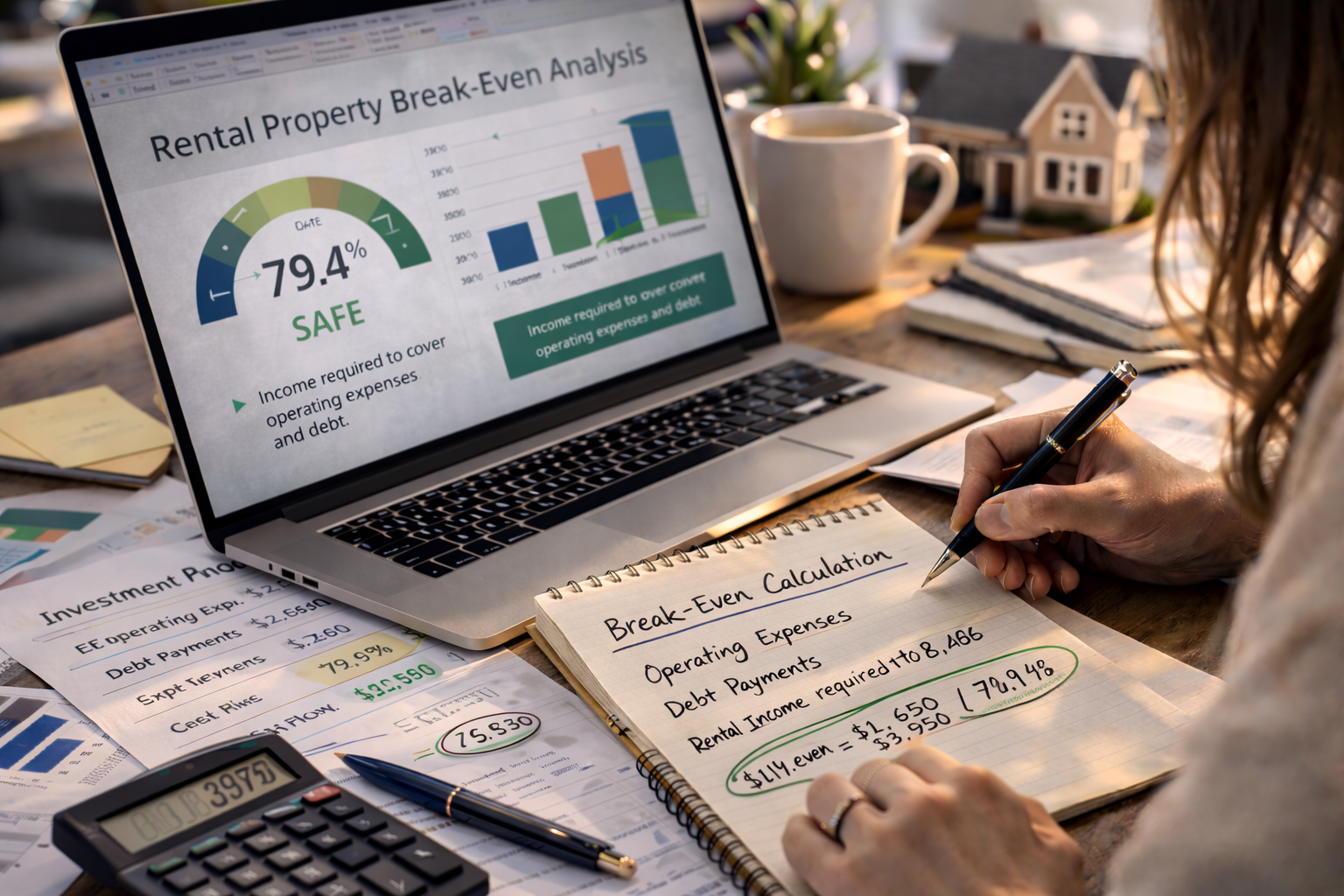
Rental Property Break Even Analysis for Real Estate Investors
Break even analysis helps real estate investors determine how much rental income a property must generate in order to cover all expenses. It provides a simple way to measure financial risk and evaluate whether a rental property can sustain itself.
Understanding break even performance is an important part of analyzing any rental investment. It helps investors estimate downside risk, prepare for vacancies, and evaluate whether a property will require additional financial support.
If you are learning rental analysis fundamentals, begin with our guide to rental property cash flow.
A rental property reaches the break even point when the total rental income exactly covers all property expenses.
What Is the Break Even Point?
The break even point represents the level of rental income required to cover the total cost of owning and operating the property. When income falls below this point, the property requires additional money from the investor to cover expenses.
When income rises above the break even point, the property generates positive cash flow.
Break even analysis helps investors understand how sensitive a property is to risks such as vacancy, maintenance expenses, and rent fluctuations.
Basic Break Even Formula
Break even analysis compares total rental income with total property expenses.
When the result equals zero, the property has reached its break even point.
If you want to learn how rental income and expenses are calculated, review how to calculate rental property cash flow.
Example Break Even Analysis
Consider the following rental property scenario:
- Monthly rent: $2,200
- Mortgage payment: $1,250
- Taxes and insurance: $350
- Maintenance reserve: $200
- Vacancy allowance: $150
Total monthly expenses:
Break even analysis:
This property exceeds its break even point and produces positive monthly income.
The larger the gap between rental income and the break even point, the more financial cushion the property has against vacancies or unexpected expenses.
Break Even Ratio
Another way investors analyze risk is by calculating the break even ratio. This ratio measures how much of the property’s income is required to cover expenses.
A lower break even ratio generally indicates a safer investment because the property requires less income to cover expenses.
- Below 70 percent relatively strong income cushion
- 70 to 85 percent moderate risk level
- Above 85 percent higher sensitivity to income changes
Why Break Even Analysis Matters
Break even analysis helps investors evaluate how resilient a property is during financial stress.
It helps answer important questions such as:
- How much vacancy can the property tolerate?
- How much rent decline would eliminate profits?
- Will the property require financial support during downturns?
- How stable is the investment over time?
Properties with lower break even points generally have lower financial risk.
How Financing Influences Break Even Performance
Financing structure can significantly affect the break even point of a rental property.
Higher loan balances or interest rates increase the monthly mortgage payment, which raises the break even income level.
Some investors analyze Debt Service Coverage Ratio alongside break even analysis to understand financing feasibility.
Learn more in how to calculate DSCR for rental property.
Many rental property loans are structured around DSCR underwriting. You can explore these financing options through DSCR loan programs for real estate investors.
Factors That Influence Break Even Performance
Several variables affect how quickly a property reaches the break even point.
- Rental income level
- Operating expenses
- Financing structure
- Maintenance costs
- Property management fees
- Vacancy rates
Small changes in these variables can significantly alter the financial stability of the investment.
How Property Operations Affect Break Even Risk
Operational performance strongly influences whether a rental property consistently exceeds its break even point.
Vacancy management, tenant screening, maintenance planning, and rent positioning all affect income stability.
Strong operational practices help investors maintain a healthy margin between rental income and expenses.
Operational discipline helps protect the financial stability of rental properties. Leasing practices, tenant screening, maintenance planning, and vacancy management all influence how consistently a property stays above its break even point. Explore more landlord education in our rental property cash flow hub.
Break Even Analysis vs Other Rental Property Metrics
Break even analysis is just one component of a complete rental property evaluation.
Investors typically analyze several metrics together, including:
- Cash flow
- Debt service coverage ratio (DSCR)
- Cap rate
- Cash on cash return
- Risk analysis
Using multiple metrics provides a more comprehensive picture of investment performance.
You can explore these metrics further in rental property return metrics.
Related Rental Property Analysis Guides
Continue learning about rental property investment analysis with these guides:
- how to calculate rental property cash flow
- rental property expenses list
- DSCR vs cash flow
- cap rate vs cash flow
- Break even analysis identifies the income level required to cover all property expenses
- The break even point indicates when a rental property becomes financially self sustaining
- Lower break even ratios indicate stronger financial stability
- Financing structure can significantly affect break even performance
- Operational discipline helps maintain healthy income margins