
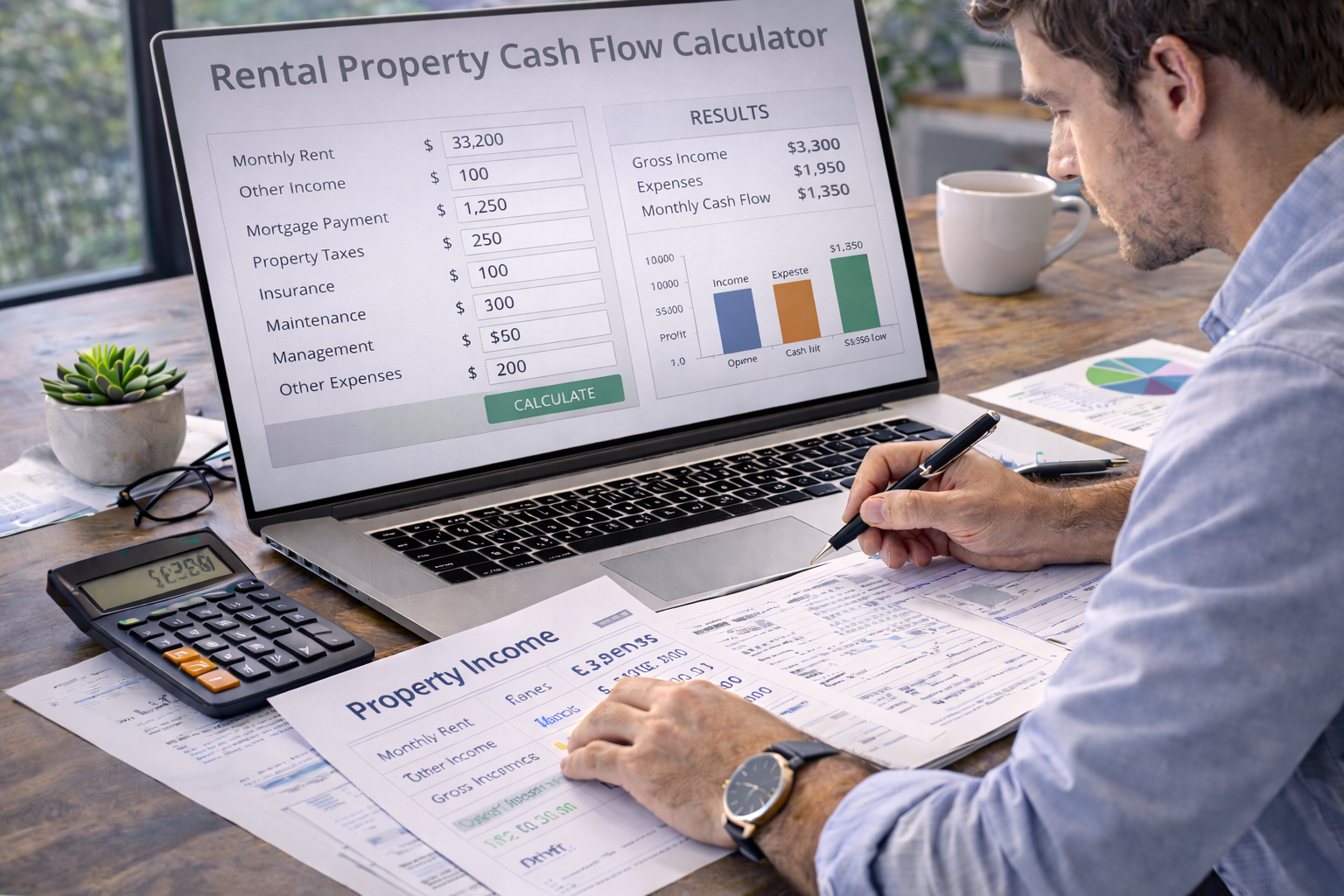
Rental Property Cash Flow Calculator Guide
A rental property cash flow calculator helps landlords and investors estimate whether a property is likely to produce positive monthly income after all major expenses are paid. It is one of the most useful tools for screening deals quickly and avoiding properties that only look good on the surface.
The purpose of a cash flow calculator is simple. It helps you compare rental income against mortgage costs, taxes, insurance, maintenance, vacancy, and other operating expenses so you can estimate what is actually left over each month.
If you are new to this topic, begin with our main guide to rental property cash flow.
A rental property cash flow calculator estimates how much monthly or annual income remains after subtracting all realistic property expenses from total rental income.
Basic Rental Property Cash Flow Formula
At its core, the calculation is straightforward:
The challenge is not the formula itself. The challenge is making sure the numbers you enter are realistic.
That means using:
- Accurate rent estimates
- Realistic mortgage payments
- Updated property tax numbers
- Actual insurance estimates
- Maintenance and vacancy allowances
Inputs a Rental Property Cash Flow Calculator Should Include
A useful calculator should include both income and expense categories. The more realistic the inputs, the more valuable the result.
Income Inputs
- Monthly rent
- Other recurring income such as pet fees or parking
- Short term rental income if applicable
Expense Inputs
- Mortgage principal and interest
- Property taxes
- Landlord insurance
- Maintenance reserve
- Vacancy allowance
- Property management fees
- HOA or condo fees
- Utilities paid by the owner
- Capital expenditure reserve
For a full breakdown of cost categories, review our page on rental property expenses.
A cash flow calculator is only as good as the assumptions you enter. Conservative numbers usually produce better decisions than optimistic ones.
How to Use a Rental Property Cash Flow Calculator
Most investors use a cash flow calculator in a few simple steps.
Step 1: Estimate Monthly Rental Income
Use current lease terms or realistic market rent rather than best case projections.
Step 2: Enter Monthly Financing Costs
Include the actual projected mortgage payment, not just the loan amount or interest rate.
Step 3: Enter Operating Expenses
Add taxes, insurance, maintenance, management, HOA fees, vacancy, and other expected costs.
Step 4: Review Monthly and Annual Cash Flow
Once everything is entered, the calculator should show the remaining monthly cash flow and often the annual total as well.
If you want the step by step method behind the tool, review how to calculate rental property cash flow.
Example Rental Property Cash Flow Calculation
Here is a simple example using conservative numbers:
- Monthly rent: $2,200
- Other monthly income: $50
- Total monthly income: $2,250
- Mortgage payment: $1,350
- Taxes: $250
- Insurance: $125
- Maintenance reserve: $150
- Vacancy reserve: $100
- Management fee: $180
- Total monthly expenses: $2,155
Estimated monthly cash flow:
$2,250 − $2,155 = $95 per month
That property may technically be cash flow positive, but the margin is thin. A small repair or rent shortfall could eliminate the profit quickly.
A calculator can tell you whether the numbers work on paper. It cannot tell you whether your rent assumptions are too aggressive, your maintenance budget is too low, or the neighborhood is weakening. Judgment still matters.
Why Landlords Use Cash Flow Calculators Before Buying
A cash flow calculator helps investors filter deals quickly. Before spending time on inspections, financing, or deeper due diligence, many landlords want to know whether the property is even close to workable.
This tool helps answer questions like:
- Will this property likely produce positive monthly income?
- How sensitive is this deal to vacancy or repairs?
- Does the financing make sense for the rent level?
- Is this property stronger than another option I am comparing?
How Financing Changes the Calculator Result
Financing often makes the difference between a property that cash flows and one that does not. A higher rate, larger loan amount, or shorter amortization can raise the monthly payment enough to wipe out positive cash flow.
That is why many investors compare financing structures while underwriting a deal. One option some investors explore is a DSCR loan, which focuses on whether the property’s rental income supports the debt payment.
For investor financing guidance, see DSCR loans for rental property investors.
Common Mistakes When Using a Cash Flow Calculator
The biggest errors usually come from what investors leave out, not from the formula itself.
- Using unrealistic rent numbers
- Ignoring vacancy
- Underestimating maintenance
- Leaving out insurance or taxes
- Ignoring HOA fees
- Forgetting management costs
- Not reserving for large future repairs
A calculator that excludes real world expenses can create false confidence.
Cash flow does not depend only on the numbers at purchase. Leasing quality, tenant screening, maintenance systems, and vacancy control all influence actual performance over time. For landlord education and operational guidance, explore Blue Castle Management.
What a Good Rental Property Cash Flow Calculator Should Help You Compare
A strong calculator should help you compare more than one property and test multiple scenarios.
Useful comparisons include:
- Higher versus lower down payment
- Different rent assumptions
- Self management versus professional management
- Lower vacancy versus higher vacancy
- Different insurance or tax assumptions
This lets you stress test a property rather than relying on one optimistic estimate.
Cash Flow Calculator vs Broader Investment Analysis
A cash flow calculator is a great starting tool, but it is not the full investment analysis. It should be paired with other decision tools and pages such as:
- what is a good cash flow on a rental property
- gross rent vs net rent
- rental property break even analysis
- risk analysis for rental properties
- rental property return metrics
The calculator gives you a screen. Deeper analysis gives you conviction.
Who Benefits Most From Using a Cash Flow Calculator
This tool is useful for:
- First time landlords
- Buy and hold investors
- House hackers comparing future rental performance
- Investors comparing multiple deals
- Landlords evaluating refinance scenarios
Anyone making a decision about a rental property should understand the likely monthly cash flow before moving forward.
- A rental property cash flow calculator estimates income left after all major expenses are paid
- The formula is simple, but the assumptions matter
- Realistic taxes, insurance, maintenance, vacancy, and management costs should be included
- Financing structure can significantly change the outcome
- The calculator is a starting tool, not a substitute for deeper underwriting